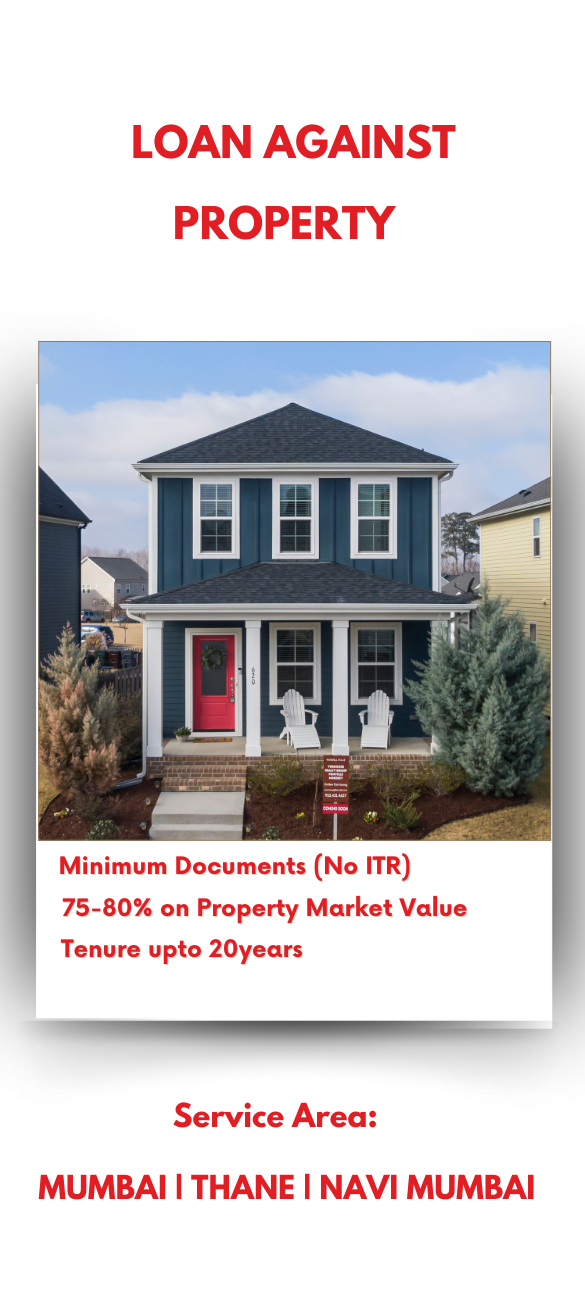
A Loan Against Property (LAP)is a type of secured loan where an individual or a business can pledge their property (residential or commercial) as collateral to borrow money from A financial institution, like a bank or non-banking financial company (NBFC), provides loans against property.
Here’s an overview of how LAP works and key features:
1. Types of Properties Eligible for LAP:
• Residential Property: Homes, apartments, or any residential
real estate owned by the borrower.
• Commercial Property: Offices, shops, or any commercial
real estate owned by the borrower.
• Land: In some cases, plots of land are also considered acceptable collateral.
2. Loan Amount:
• Loan against property (LAP) generally has lower interest rates
than a loan that does not require you to provide any collateral
to avail them like personal loans.
• LTV typically ranges from 70% to 75% depending on the lender,
property type, and borrower’s financial profile.
• For example, if the property is valued at ₹1 crore,
and the lender offers an LTV of 75%, you may be eligible for a
loan up to ₹75 lakh.
3. Interest Rates:
• Interest rates on LAP are generally lower than unsecured
loans like personal loans since the loan is secured against property.
• Rates vary based on the lender, the type of property,
and the borrower's creditworthiness.
• Interest rates can be either fixed or variable, depending on the loan terms.
4. Repayment Tenure:
• LAPs typically have longer repayment tenures compared to
other types of loans, ranging from 5 to 20 years.
• Longer tenures result in lower monthly payments, but the
overall interest paid over time might be higher.
5. Eligibility Criteria:
• Age: Generally, borrowers must be between 21 to 60 years of
age at the time of loan application.
• Income: The borrower must have a consistent income source, either
salaried or self-employed.
• Credit Score: A good credit score is important, though LAP may be
approved with a lower score compared to unsecured loans.
• Property Ownership: The borrower must own the property they wish
to pledge, and the property should be free from legal disputes.
6. Advantages of Loan Against Property:
• Lower Interest Rates: LAP typically offers lower interest rates
compared to unsecured loans like personal loans.
• Higher Loan Amounts: LAP can allow borrowers to access larger
loan amounts because the loan is secured by property.
• Longer Repayment Tenure: Repayment can span several years,
lowering the EMI burden.
• Flexible Usage: The loan can be used for various purposes,
such as funding business expansion, education, home renovation,
or even personal needs.
7. Disadvantages of Loan Against Property:
• Risk of Property Loss: Since the loan is secured by property,
failure to repay can lead to foreclosure, meaning the lender can
take possession of the property.
• Long Processing Time: The approval process may take longer
due to property valuation and legal checks.
• High EMI Burden: Even though LAP has a long tenure, the
EMI might still be high depending on the loan amount and interest rates.
8. Loan Disbursement Process:
• Application: You apply for a LAP with the required
documents like proof of identity, address, property documents,
income proof, and credit score.
• Property Evaluation: The lender will assess the market value
of your property, often through an independent evaluator.
• Approval & Agreement: Once approved, a loan agreement will be
signed between the borrower and lender outlining the loan amount,
interest rate, repayment terms, etc.
• Disbursement: After signing the agreement, the loan is disbursed either as a lump sum or in installments, depending on the purpose.
9. Common Uses of Loan Against Property:
• Business Expansion: Many entrepreneurs use LAP to
finance the growth or expansion of their businesses.
• Debt Consolidation: Some borrowers use LAP to pay
off high-interest debts like credit card bills or personal loans.
• Medical Expenses: It’s a way to raise funds for expensive
medical treatments or emergencies.
• Education and Higher Studies: Some people take a LAP for
financing higher education, both domestically and abroad.
• Home Renovation or Construction: LAP can also be used for
property repairs or new construction.
10. Key Considerations
• Due Diligence: Always ensure that you have a clear understanding
of the loan terms and the repayment schedule.
• Property Valuation: Be cautious about overvaluing your
property for the loan application, as excessive borrowing may
lead to difficulty in repayment.
• Repayment Plan: Ensure you have a reliable plan for repaying the
loan to avoid the risk of losing your property.
Conclusion:
A Loan Against Property can be a powerful financial tool,
especially for individuals or businesses looking to leverage
their property to access substantial funds at lower interest rates.
However, because your property is at stake, it’s crucial to borrow
wisely and ensure that you have the financial capability to manage
the repayment.